


.avif)
Credential stuffing is an automated cyberattack where attackers use stolen username and password combinations to gain unauthorized access to user accounts. Attackers obtain massive lists of compromised credentials from data breaches. These lists are readily available on the dark web, containing millions of username and password pairs. They then use automated bots and special softwares to test these stolen credentials across multiple websites and apps at scale.
Success rates hover between 0.1% to 4%. This number might sound small until you realize attackers are testing millions of credentials simultaneously. Even 1% success rate means 10,000 compromised passwords.
Why old-school defenses keep failing
The attack is hard to spot because login attempts are often made only once per system, and IP address spoofing disguises the source. Rate limiting helps with brute force attacks where you see repeated attempts from the same IP. But credential stuffing is different. Attackers now operate with mature tools, shared playbooks, and infrastructure designed to evade traditional detection.
AI agents are making things worse. These autonomous tools can bypass CAPTCHAs, recognize and evade detection systems, and mimic legitimate user behavior.
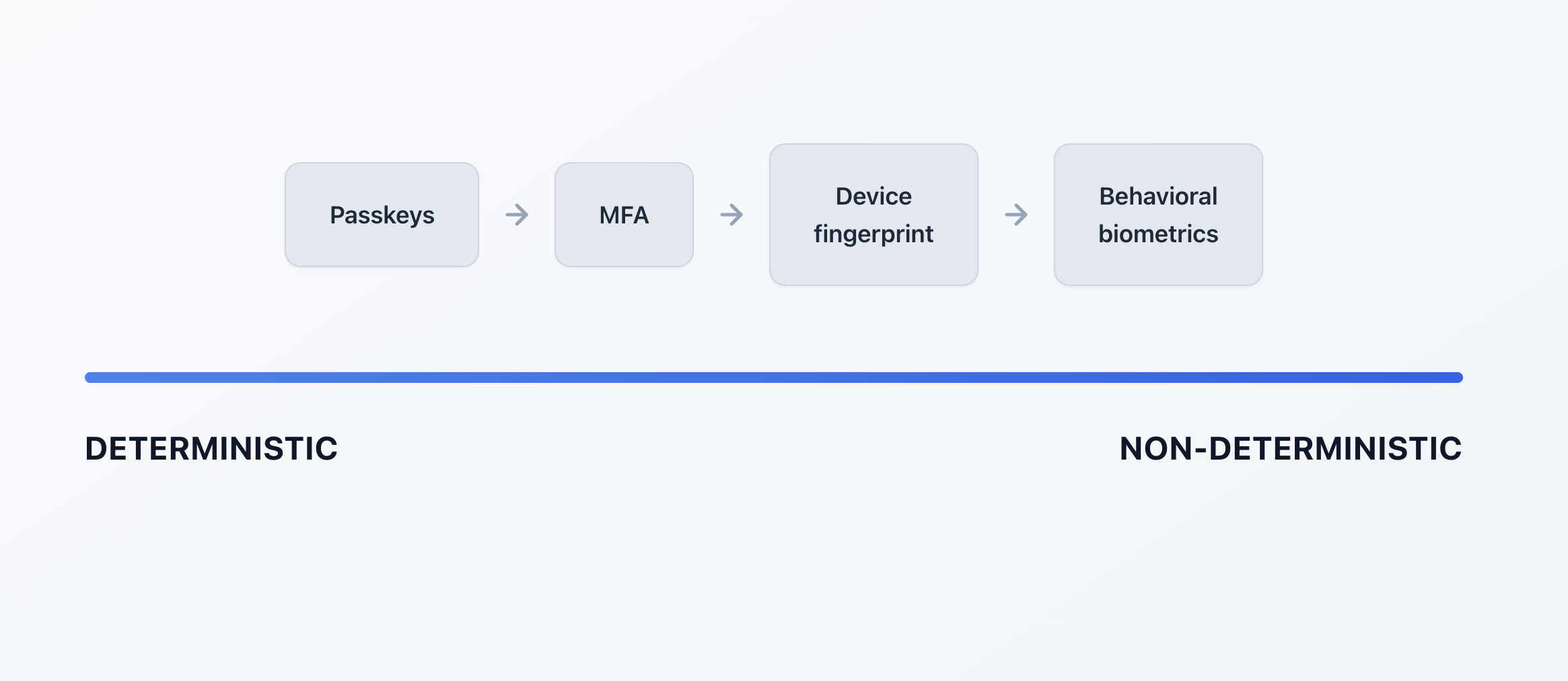
What actually works
Multi-factor authentication (But make it smart)
MFA adds an extra layer of security by requiring multiple forms of verification. But the problem with MFA is nobody wants to enter an OTP code every single time they log in. The solution is adaptive MFA. Rather than applying static MFA challenges, implement adaptive authentication that evaluates risk factors such as device type, user behavior, login frequency, and historical access locations. Anomalous login attempts, such as a sudden login from an unusual country or multiple failed attempts followed by a success, should trigger additional verification steps dynamically.
Push notifications are an effective way to deliver these adaptive challenges. Users get a notification on their phone, tap to approve, and they're in. This provides strong security while keeping the process quick and frictionless. The key is triggering push authentication only when risk signals warrant it.
This way legitimate users on recognized devices get one-click access and suspicious patterns get challenged. Authsignal makes it easy to implement risk-based MFA policies that adapt in real time based on the signals you care about. Learn more about it here.
Device fingerprinting and behavioral biometrics
Device fingerprinting creates a unique digital ID by collecting hardware, software, and behavioral data from devices. It tracks users more persistently than cookies, working across browsers and devices even after clearing cookies.
As IP addresses and user agents become less reliable and cookie-based tracking continues to degrade, device fingerprinting remains one of the few techniques capable of consistently tying activity to a specific device.
But fingerprints alone aren't enough. Behavioral biometrics uses AI and machine learning to turn human behaviors into biometric data. It looks at dynamic actions such as typing patterns (how a person types, including speed and rhythm), mouse movement patterns (speed, direction, and acceleration), and other unique user behaviors.
Bots can steal credentials. They can rotate IPs. They can solve CAPTCHAs. But they can't replicate the subtle patterns of how you type, move your mouse, or navigate a site.
Passkeys
Passkeys eliminate the problem at its root. Passkeys are cryptographically bound to the specific domain they were created for. A passkey for yourbank.com cannot be used on a fraudulent site, even if the user is tricked. Each passkey is a unique key pair, so there is no shared secret for attackers to steal from one breached service and reuse on others. Servers only store the public key, which is useless for authentication without the corresponding private key that never leaves the user's device.
Breaches of password databases (which can be an attractive target for hackers) no longer pose a threat as there are no passwords to steal. No reused passwords means no credential stuffing. The attack simply doesn't work.
User experience advantage with passkeys
The login process becomes seamless. Users authenticate with a single tap using their fingerprint or face. According to the latest FIDO Alliance Passkey Index from October 2025, passkeys achieve a 93% login success rate compared to just 63% for traditional authentication methods. That's a 30% improvement in reliability. Passkey authentication takes an average of 8.5 seconds compared to 31.2 seconds with traditional MFA. That's a 73% reduction in login time.
Users aren't fumbling with password managers or trying to remember which variation they used on your site. They just authenticate with their fingerprint or face and they're in. The data shows real adoption too. Among major platforms that have deployed passkeys, 36% of accounts now have passkeys enrolled, and 26% of all sign-ins are already using passkeys.
Financial savings with passkeys
The global average cost of a data breach reached $4.45 million in 2023. Direct financial losses from credential stuffing include refunds, chargebacks, gift card laundering, and loyalty point restitution. Operational drag includes help desk queues surging with lockouts and forced resets. Peak events can triple call volume, driving overtime costs or SLA penalties.
Passkeys eliminate these costs. Recent data from the FIDO Alliance Passkey Index shows platforms using passkeys report up to an 81% reduction in sign-in related help desk incidents. Password reset tickets disappear. Authentication costs drop as you eliminate OTP sends. Bot traffic that eats your infrastructure budget gets blocked at the door.
The cost savings from fewer support interactions and reduced authentication overhead free up budget for innovation while simultaneously reducing fraud losses.
Making the shift
Credential stuffing thrives on reused passwords and static login flows. Rate limiting is necessary but not enough on its own.
The real defense combines adaptive authentication, behavioral analysis, and ultimately, eliminating passwords altogether. Passkeys aren't just more secure. They're easier for users and cheaper to operate.
Technical readiness is no longer the barrier. According to the latest FIDO Alliance data, 93% of user accounts are already eligible for passkeys. The infrastructure is there. The user devices support it. Major platforms like Amazon, Google, Microsoft, PayPal, and Target have successfully deployed passkeys and are seeing real results.
Authsignal makes it straightforward to implement these without rebuilding your auth system. Adaptive MFA, passkey support, and risk-based authentication policies that you can configure and deploy fast.
.avif)
.avif)
.avif)